| Home |
|
|
|
|
|
![]() |
|||||||
|
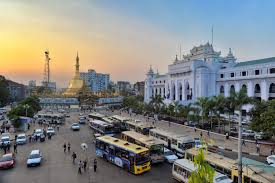
YANGON Yangon, the capital city is the gateway to Myanmar. Having many shady parks and beautiful lakes, Yangon has earned the name of " the Garden City of the East".
When King Alaungpaya captured the riverside village of Dagon from the Mons in 1755, he renamed it Yangon - " the end of war". In 1851, the British annexation of Yangon resulted in getting the town refounded and became the capital. The new city was remodelled and constructed by Lieutenant Fraser, a British Officer of the Engineering Corps who also designed and constructed Singapore.
Shwedagon Pagoda :Towering the green city-scape of Yangon, the Shwedagon Pagoda is the prominent landmark visible from miles around. One of the wonders of the world, the Shwedagon is believed to have been built since 2,500 years ago during the Buddha's life time.
Kaba Aye Pagoda : It is significant for the Sixth World Buddhist Synod which was held in its large compound in 1954. The Buddhist Art Museum and Maha Pasana Cave are also located in the same compound.Sule Pagoda: Situated right in the centre of Yangon --- is an excellent landmark. It is said to be over 2,000 years old. The pagoda is said to enshrine a hair of the Buddha. |
|||||||
|
Botahtaung Pagoda: The Botahtaung Pagoda was named after the thousand military leaders who escorted relics of the Buddha brought from India over two thousand years ago.
Bogyoke Aung San Market: Bogyoke Aung San Market was first built in 1926. It was named Scott Market after Mr.C.Scott, the then Municipal Commissioner. Nowadays ,the name was changed to Bogyoke Aung San Market in honour of our national leader General Aung San. There are some 2,000 shops selling luxury items, handicrafts, food stuffs, clothing, jewellery, fashion and consumer goods. Other places of interest: Chinatown, Chaukhtatgyi Pagoda (reclining Buddha), National Museum, Gem Museum, etc. |
|||||||
|
|
|||||||
|
KYAIKHTIYO ( THE GOLDEN ROCK )
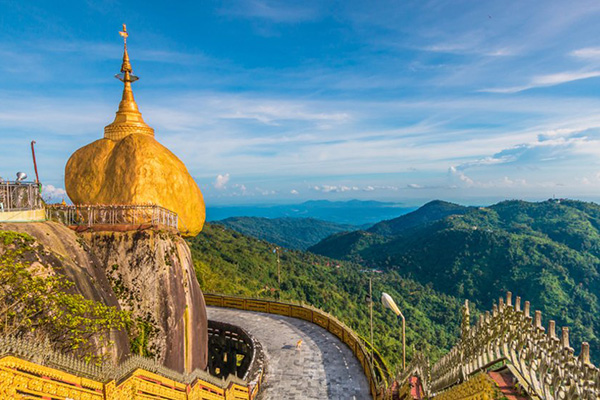
Kyaikhtiyo Pagoda well known as the Golden Rock located 160 km from the east of Yangon, in Kyaikhto Township, Mon State. It is one of the famous pagodas in Myanmar and is about 3,600 feet above sea level. The hill on which the Kyaikhtiyo Pagoda stands is also called the Kyaikhtiyo Hill. On the Kyaikhtiyo Hill, there is a huge and steep rock. A big boulder the circumference of which is about 50 feet, rests on top --- to be exact --- on the edge of the rock. At a glance, it seems that the boulder will fall at a slight push.
The boulder is in the shape of a human head. A small pagoda 23 feet high, was built on top of that boulder. By using a piece of bamboo strip as a lever, with a piece of thread tied to one end and placed under the rock you can pass the thread from one side to the other side of the boulder which goes to show that the boulder supporting the Kyaikhtiyo Pagoda does not touch the rock below it.
The pagoda on top of the boulder is called in Mon language Kyaik-I-thi-ro, which means "pagoda carried by a hermit on his head" Kyaik-I-thi-ro later came to be known as Kyaikhtiyo Pagoda. |
|||||||
|
|
|||||||
|
On the Southern coast lies Mawlamyine, a picturesque old colonial town once an important teak port. Places of interest in this area include the Mahamuni and Uzina Pagodas, Kipling's Kyaikthanlan Pagoda and the Mon Cultural Museum. Nearby places of interest include Setse Beach, Kyaikhami- a seaside resort with its Yele pagoda perched over the sea and Thanbyuzayat War Cemetery where allied prisoners of World War II's died while building the infamous ' Death Railway'. |
|||||||
|
|
|||||||
|
Pyay is located 285 km north west of Yangon, previously called Sri Ksetra, an ancient city of Pyu era, existed during the period from A.D 300 TO A.D 1000. That is to say , Sri Ksetra had been in existence for more or less 700 years before the foundation of Bagan Dynasty in 1044 A.D by King Anawrahta. Tour Highlights are Shwe Sandaw Pagoda, Shwe Nat Taung Pagoda, the unique Buddha image with glasses (special interest place in Shwe Daung), the ancient ruins of Sri Ksetra and Hmawza, Baw-baw-gyi Stupa, Payama Stupa, Payagyi Stupa, and Be`-be` Temple, Akauk Taung- beautiful Buddha images carved in the rocky banks along the Ayeyarwaddy river. |
|||||||
|
|
|||||||
![]() |
|||||||
|
BAGO Bago(Pegu), 80 km north of Yangon. It was the capital city of Myanmar in the reign of King Bayinnaung during 16th century and of the Hamsavati kingdom for many centuries under the Mon and Myanmar Kings.Shwe Mawdaw Pagoda: Shwe Mawdaw is regarded as the greatest pride of Bago. Shwe Mawdaw was first built over 2,000 years ago. Shwe Mawdaw is 373.75 ft in height --- even some 50 ft higher than the great Shwe Dagon. Shwe Thalyaung Image(Reclining Image): This colossal reclining image of Buddha is 180 feet in length and 52.5 feet in height. This is one of the largest reclining Buddha images in the world.
|
The Hanthawadi Palace: Kanbawza Thadi, the famous palace of King Bayinnaung (1551-1581 A. D.) is being extensively excavated and some buildings are being rebuilt
Other places of interest: Mahazedi (the Great Stupa) built by King Bayinnaung in 1560 A. D., and Hinthakone Pagoda, Kalyani Sima , the famous sacred ordination hall built in the 15th century, and Kya kut wine monastery which is the famous teaching centre for the monks. |
||||||
|
|
|||||||
|
|||||||
|
|
|||||||
|
There is often some confusion over Mt. Popa and Taung Kalat or Temple Hill. Toung Kalat is a comparatively modest volcanic plug thickly clothed in temples and shrines and believed to be the abode of spirits. It is sometimes referred to as Mt. Popa. But not far away is the real Mt. Popa which is an extinct volcano nearly 5,000 feet in height and covered with a recently-grown forest . The name Popa is have derived from a pali word meaning flower, so Mt. Popa means a mountain of flowers. Hence, Mt. Popa covered with trees is like an oasis in desert-like Central Myanmar Plain. Mt. Popa is an excellent place for trekking along the volcanic crater. |
|||||||
|
|
|||||||
![]()
Great Maha Muni Pagoda: Originally, this holy image belonged to Myohaung in Rakhine State, the western coastal region of Myanmar. In 1784, King Bodawpaya brought the image to the royal capital at Amarapura. It has been 210 years since the Holy Image first arrived at the central Myanmar. The image is also regarded as the greatest in Myanmar next to the Shwe Dagon.
Atumashi Kyaung: which literally means the inimitable monastery. Actually, it is just the ruins partly survived the fire in 1890. However, nowadays, it has been reconstructed by Myanmar government.
Other places of interest: the Shwe Nandaw monastery (famous for its finest wood carving), Shwe In Pin Monastery, Zay Cho Market, Stone carving, Wood carving, Silk Weaving, Tapestry Workshop, Bronze Casting Workshop etc.
|
MANDALAY The City lies in the heartland of Myanmar 620 kilometres north of Yangon. It is the second largest city that stands as a pride of Myanmar where characteristics closest to genuine Myanmar can be found.
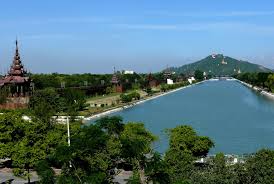
Mandalay was founded in 1857 as the capital by King Mindon and remained the capital city of the Konboung, Myanmar's last dynasty. The Mandalay Palace boasts finely built palace walls and a beautiful moat surrounding this fortress. Moreover, Mandalay is not only an important city for Myanmar culture, but also the principle centre for Buddhism studies in Myanmar. Mandalay's monasteries and pagodas are of great religious significance to all Myanmars.
Mandalay Hill: 236 metres (775 ft) high. From the top of the hill, one can have a panoramic view of the city including the royal moat and the palace.Kyauktawgyi: was completed in 1878. It contains an image of the Buddha carved out of a single marble boulder.
Kuthodaw: was constructed by King Mindon in 1857. The pagoda is famous for "the World Largest Book " which is the collection of 729 marble slabs on which are inscribed the whole Buddhist scriptures.
The Palace: The fortified ancient palace or city is in the form of a square each side of which is 2 miles in length. A battlemented wall of brick and mud mortar has a total height of 25 feet and is backed by an earthen rampart. The moat is 225 feet wide and 11 feet deep in average, surrounding the city. Of the five original wooden bridges spanning over the moat, four lead to the main gates. |
||||||
|
Great Maha Muni Pagoda: Originally, this holy image belonged to Myohaung in Rakhine State, the western coastal region of Myanmar. In 1784, King Bodawpaya brought the image to the royal capital at Amarapura. It has been 210 years since the Holy Image first arrived at the central Myanmar. The image is also regarded as the greatest in Myanmar next to the Shwe Dagon.
Atumashi Kyaung: which literally means the inimitable monastery. Actually, it is just the ruins partly survived the fire in 1890. However, nowadays, it has been reconstructed by Myanmar government.
Other places of interest: the Shwe Nandaw monastery (famous for its finest wood carving), Shwe In Pin Monastery, Zay Cho Market, Stone carving, Wood carving, Silk Weaving, Tapestry Workshop, Bronze Casting Workshop etc. |
|||||||
|
|
|||||||
|
SAGAING Sagaing lies 21 km south-west of Mandalay on the west bank of the Ayeyarwaddy River. Sagaing became a capital of an independent Shan kingdom around 1315 AD. after the fall of Bagan. Today, Sagaing is known as a meditation centre. Myanmar people visit Sagaing for the purpose of religious retreat.
Sagaing Hill: It is known as a religious retreat where over 600 monasteries for monks and nuns are located for Buddhistic studies and meditation. It is a nice place to enjoy the sunset from the Hills.
Kaunghmudaw Pagoda: The enormous dome rises 46 metres(151 feet) in the shape of a perfect hemisphere and was modelled after the Mahaceti Pagoda in Ceylon. The pagoda was built in 1636.
Other place of interest: Inwa Bridge, Thabyedan Fort and Silver work shop etc. |
![]() |
||||||
|
|
|||||||
![]() |
AMARAPURA Situated about 11 km south of Mandalay, it is an ancient capital of King Bodawpaya of the Konbaung Dynasty in 1783. Amarapura is noted for silk and cotton weaving and bronze casting.
U Bein's Bridge: a 1.2 km long teak wood bridge over the Taungthaman Lake. It was built by the City's Mayor U Bein in 1784. This old bridge has stood the test of time for two centuries.
Maha Gandayon Monastery: the largest in Myanmar with over 1,000 monks during Lent and about 700 at other times. It follows the original teachings of Buddha and has very high academic standard.Other tour highlights : Kyauktawgyi Pagoda, Shwe Kyet Kya and Shwe Kyet Yet Pagoda, etc. |
||||||
|
|
|||||||
|
MINGUN It is about 11 km upriver from Mandalay on the opposite bank of the Ayeyarwaddy and accessible only by river. A 45-minute boat trip to Mingun lets travellers experience life along the river. Mingun Bell : Weighs 90 tons and is the largest hung and uncracked ringing bell in the world. It was built by King Bodawpaya in 1790 AD. Other places of interest: Mingun Pagoda, Pondawpaya, Myatheindan Pagoda, Settawya Pagoda, etc. |
![]() |
||||||
|
|
|||||||
|
INWA Located at the confluence of the Ayeyarwaddy and Myit nge rivers, it lies to the southwest of Amarapura. From 1364, Inwa was the capital of a Myanmar kingdom for nearly 400 years until the shift was made to Amarapura in 1841.
Places of interest: Ava Fort, Bagaya Kyaung Monastery, Watch Tower, Maha Aung Mye Bonzan . |
|||||||
|
|
|||||||
|
PYIN OO LWIN ( Maymyo ) It is 40 miles from north east of Mandalay and is a popular hill resort town perched a top the 3,500-ft table mountain.Pyin Oo Lwin used to be known as " Maymyo " when it was built in 1886. "Maymyo" is said to have been named after one colonel May, commanding officer of the Bengal Infantry regiment that was stationed in Pyin Oo Lwin.
Purcell Tower: is a historical landmark , 75 feet high, right in the middle of the town. It is said to be one of the ten clocks made in 1934 in commemoration of the silver jubilee of the reign of King George V of the United Kingdom.
Places of Interest: Botanical Garden, Pyin Oo Lwin market, Anisakan Waterfall, Pwe kauk Waterfall, Peik Chin Myaung Cave,and a ride on a horse-drawn stage coach through the town. |
![]() |
||||||
|
|
|||||||
|
MONYWA About 140 km, west of Mandalay, Monywa is the monnercial centre of the Chindwin valley. It is an important transit point for goods coming down the Chindwin river and is in a gretty position right on the river.
Places of Interest are - Thanbokde Pagoda with 582357 Buddha Images, Bodhitahtaung Pagoda, Kyaukka- Shweguni Pagoda, Powintaung, Twintaung ( 33km north of Monywa and is an extinct volcano with a lake in the crater) |
![]() |
||||||
|
|
|||||||
|
LASHIO It is a must night stop for the visitors who like to visit Myanmar through China-Myanmar border from Muse gate way. Lashio itself is a gathering place for the people of northern Shan State who come here from remote valleys to do their trading at the market.Places of interest are a Chinese Temple, Thathana 2500 Pyilone Paya, Magnificant Goteik Bridge lying on the railway to Maymyo (Pyin Oo Lwin) built in 1903. |
|||||||
|
|
|||||||
|
MOGOK ( Ruby Land ) Mogok, the land of richest gems in the world, is situated 200 km north east of Mandalay. We can visit famous mines of rubies and sapphires with special permit. |
|||||||
|
|
|||||||
![]() |
TAUNGGYI Taunggyi is situated in the southern Shan State and is the capital of Shan State. It is 4,712 feet above sea-level and has a moderate climate. It is situated on a high plateau surrounded by high mountains.
Places of Interest: Myoma Market, a place where people from the environs used to flock only once every five days to buy and sell their regional products. It is the gathering point of different national races residing in Taunggyi. The Cultural Museum and "Hawnans" (palatial residences) where the Shan Sawbwas (Shan Chieftains) used to live.
The most significant festival in Taunggyi is the Tazaungdine Lighting Festival. During this festival, hot-air balloon competitions are held. People would flock to the open field where these competitions, in the day time, are in progress and where hot-air balloons of various shapes, sizes, colours and designs float across the sky. |
||||||
|
|
|||||||
|
INLE LAKE Inle Lake is the most famous scenic spot in the Shan State. It is about 30 km south of Taunggyi, capital of the Shan State. The Lake is 22.4 km long and 10.2 km wide, shallow and extremely picturesque. It is studded with floating islands formed by the growth and decay of vegetation.
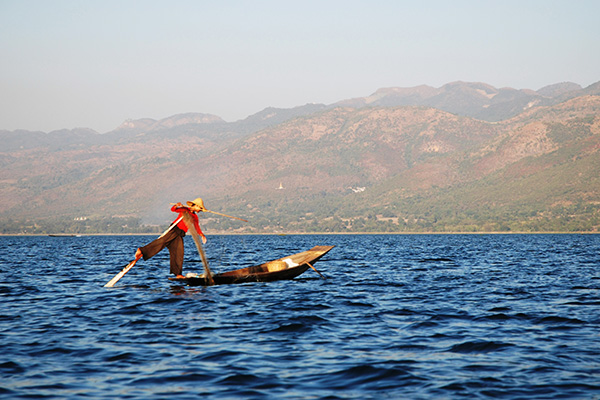
Sheltered among the hazy blue mountains, the Lake is about 900 metres above sea-level. The Lake is very popular with foreign tourists. It is famous for its unique leg-rowers, floating villages and colourful floating markets and festivals.Phaung-daw-Oo Pagoda in the Inle Lake is also very famous. It is the shrine of five Buddha images.
Phaung-Daw-Oo Pagoda festival is held every year during the month of Thadingyut (October) with great pageantry.In Eastern part of Inle lake, it is good for trekking to the villages named Kan-Taw, Htut-Eain, Nam-Nwe, Khone-sone and Lwe Khaw where Pa-oh hill tribes live. |
![]() |
||||||
|
|
|||||||
|
PINDAYA Pindaya , 45 kilometres ( 28 miles ) north of Kalaw, is picturesquely situated at the foot of the Menetaung Range with a small lake immediately in front of it. This small quiet town is famous for its caves. There are thousands of centuries old Buddha images in these caves, some of which are richly gilt. The Buddha images are of various sizes, some carved in the face of the rock and some deposited in niches in the walls. The road from Kalaw to Pindaya passes through a countryside of great scenic beauty. |
![]() |
||||||
|
|
|||||||
|
KALAW It is a peaceful summer resort with many lovely walks and fragrant pinewoods and situated about 71 kilometres (44 miles) west of Taunggyi. A beautiful hill station surrounded by mountains , it is trekking area to the vicinity of Kalaw. The destinations for trekking are Ywa Thit, Tar Yaw, Nyaung-Gone, Shwe Min Bone, Pain Ne Bin villages on the hill where Danu, Pa-oh and Palaung hill tribes live. Kalaw also has a five-day market where you can see hill tribes people in their colourful costumes. |
|||||||
|
|
|||||||
|
MRAUK-U Also known as Dannyawady, is the town in which generations of Rakhine kings built their palace. It is situated some fifty miles from Sittway on the banks of Shwenatpyin Tributary of the Kispanadi or Kaladan River. Mrauk-U was built by King Min Saw Mun in 1430 A.D. Mrauk-U is a town where there are many ancient cultural works and the pride of Rakhine State. Unlike the temples of Bagan, the temples in Mrauk-U are constructed with stones rather than the traditional bricks in a truly unique style.
Places of Interest are -
Shikthaung Stupa: built by Rakhine king Minpargyi and Queen Phwa Saw in 1535 AD. Inside the stupa, altogether 80,000 Tooth and Hair Relics are said to be enshrined
Andawthein Pahto: built by King Minrazagyi in 1596 A.D.
Htokekanthein Pahto: built of rock by King Phalaungmin inside which are depictions of attires of courtiers, their hair styles and statues of dancers in different dance steps.
Archaeological museum: situated inside the old palace walls where there are objects of art depicting the high cultural standard of the Rakhine nationals. The cultural objects on exhibition are earthernware, gold and silver ware and silver coins, among others.
Mahamuni Pagoda: situated in Teinnyo village in Kyauktaw Township about 12 miles away from Mrauk-U Township. This pagoda was built by King Sanda Thuriya under the permission granted by Lord Buddha when He came to Dannyawady. |
![]() |
||||||
|
Yadanabon Zedi, Laymyetnar Pahto and other pagodas. There are Thet Villages in the vicinity of Mrauk-U where Thet tribes with huge ear rings live. They are one of the tribes which had first migrated into Myanmar. In Mrauk-U Township, one can also experience the Rakhine traditional boat race held during the pagoda festival of Shikthaung Stupa. |
|||||||
|
|
|||||||
|
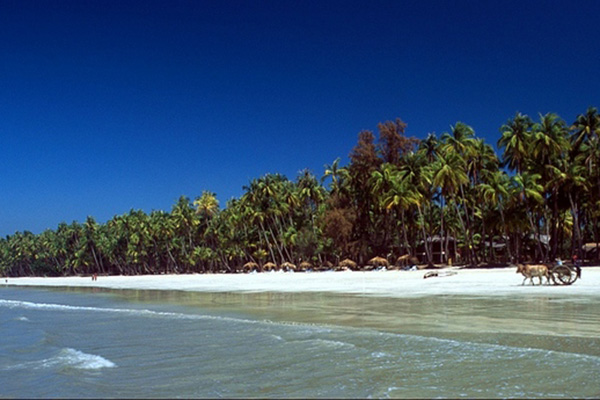
NGAPALI BEACH It is the most popular beach resort for locals and foreign visitors due to its white sand and clear water and peace and quiet for all. It is located in the western coast of Myanmar facing the Bay of Bengal. Ngapali beach lies about four miles away from Thandwe and it is easily accessible by flights from Yangon. Ngapali is not a Myanmar word. The British occupied Rakhine at the end of the first Anglo-Myanmar War in 1826. After the British occupation, Italians arrived at the beach near Thandwe. As the beach was very beautiful and pleasant like the Italian town of Naples, they named it Naples. With the passage of time, the transvocalization was degenerated into Ngapali. |
![]() |
||||||
|
|
|||||||
|
CHAUNGTHA BEACH Chaungtha, a village in Pathein West township, Ayeyarwaddy Division, lies on the beautiful unspoiled beach, just 37 miles from Pathein. Chaungtha Beach Resort is named after the scenic beauty of Chaungtha Creek that flows into the sea. The races such as Rakhines, Kayins and Bamars , live in Chaungtha Village. It takes only five hour drive from Yangon to Chaung Tha. Hence it becomes a popular beach resort for recreation and enjoying sea food and coconut juice. |
![]() |
||||||
|
|
|||||||
|
KYAING TONG Kyaing Tong is known for its scenic beauty and colourful hill tribes. It is situated in the Eastern Shan State, 452 km in the east of Taunggyi and 176 km from Tachilek, the town at the border of the Thailand. It can be accessed by plane from Yangon as well as from Thailand by crossing the border line via Tachilek. Places of interest in Kyaing Tong include the Spa, Naung Tong Lake, Sunn Taung Monastery, One Tree Pagoda, the central market and Traditional lacquerware and weaving workshop. In the vicinity of Kyaing Tong, there are villages resided by minor ethnic groups such as Gon, Lwe, Li, Wa, Lah Hu, Thai Nay, Shan, Li Shaw and Akar. So one can feel the atmosphere of traditions, cultures and life styles of these tribes which are still unspoiled by the modern facilities. One can enjoy the traditional dances and music around the camp fire. About 33km away from Kyaing Tong is Loi Mwe, a small hill station. There remains many buildings nostalgic of colonial period and an old catholic church. |
|||||||
|
|
|||||||
|
KACHIN STATE It is the northernmost tip of Myanmar with snow-capped mountain ranges and temperate forests. Places of interest include -Putao- northernmost town of Myanmar and offers views of the Mt. Khakaborazi 5889 metres peaks - Myanmar's highest mountain. Myitkyina - is the capital of Kachin State. We can see a number of hill tribes in the Myitkyina market. It is also the starting point to visit Myit sone, the confluence of Maikha and Malikha, the source of the Ayeyarwaddy River.Bamaw - is the most northern navigable point for lager vessels on the Ayeyarwaddy river. Being close to the China border, Bamaw traditionally has been a centre of trade. Hpakant- the area of Jade mines where the jade of the world best quality are being excavated. One can observe various methods of jade mining as river type, open pit type, mountain cut type etc. |
|||||||
Web Developer: Myanmars.NET, Yangon, Myanmar.
© Copyright 2000-2006 by Golden Express Tours.